
· Elena Marsh
Buckwheat vs Millet Hull Pillow: Feel, Noise, Weight and Which Sleepers Each Suits
The two names come up side by side in every search for a hull pillow, as if they were interchangeable. They are not. The shells differ in size, shape and surface, and every difference you feel on the pillow, the give, the sound, the height at three in the morning, traces back to that. This guide compares them property by property, then says which sleepers each fill suits. Buckwheat against down, polyester and memory foam is a separate comparison, on our buckwheat pillow homepage.
Two seeds, two shells: what is inside each pillow
Buckwheat hulls are pyramids with the seed taken out: three faces, defined edges, a hollow inside. They do not roll; they tip, catch on each other and settle into a loose lattice with open space between the pieces. Millet hulls are tiny, rounded and smooth, and they pour more like coarse sand: they roll, slide and settle into a close, even mass with little air between them.
Everything that follows comes from that one difference: angular hollow shells lock and trap air, small smooth shells slide and pack. For the buckwheat hull on its own terms, see our buckwheat hull pillow page; this article stays on the comparison.
Feel: a fill that holds versus a fill that flows
| Property | Millet hulls | Buckwheat hulls |
|---|---|---|
| First contact | Soft and yielding, close to a beanbag | Firm and textured, pushes back slightly |
| A shape you press in | Shallow, spreads as the hulls roll apart | Deep and stable, the hulls wedge against each other |
| Height through the night | Settles lower and wider as you move | Stays where you set it |
| Texture through the cover | Fine and even | Coarser, individual hulls can be felt |
The softness of millet is real: no single hull registers through the cover, and because the hulls roll rather than lock, the pillow molds to the head the way a beanbag does. The same property has a second half. A fill that flows to accept your head also flows away from it, and the mound built at bedtime is lower and wider by morning.
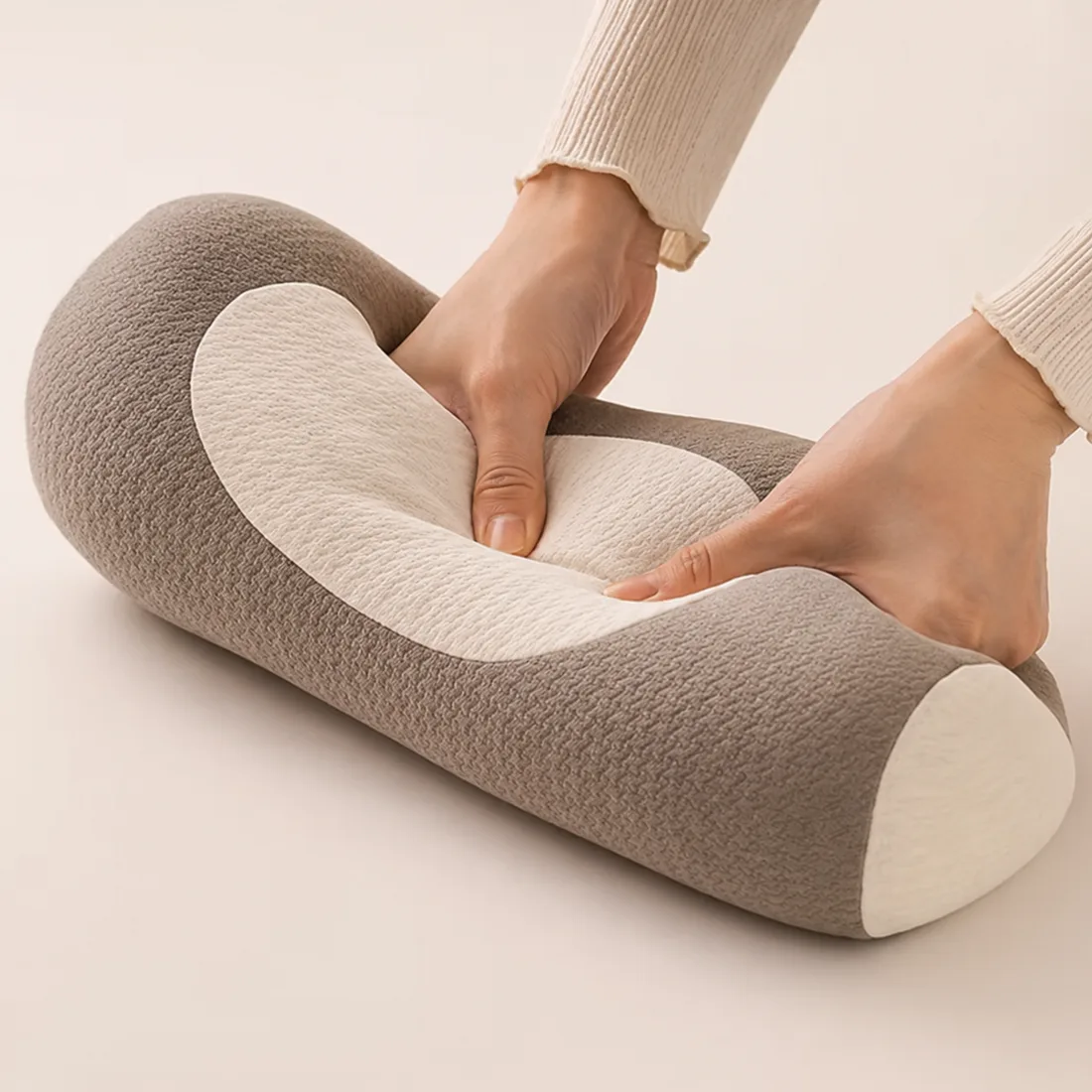
Buckwheat does the opposite: the hulls read as a texture, and the pillow pushes back instead of swallowing the head. Press a hollow into it and the hulls tip against each other and jam; the hollow keeps its walls until you change it. That is what lets a cylinder hold the gap between ear and shoulder all night; how much height each position needs has its own article: buckwheat pillow for back and side sleepers.
Noise: why buckwheat rustles and millet does not
Millet earns its reputation here: the hulls have no edges to catch on, so the fill shifts under the head with almost nothing to hear. The buckwheat rustle is hulls with corners tipping against each other as you move, and it is also the mechanism: the friction that makes the sound is the friction that holds the shape, and one does not exist without the other.
What changes over time is not the sound but the listener: the pillow only rustles when you move, and you are the one moving, which is why most sleepers stop registering it within the first few nights. The 30-day money-back window on the HuskRest pillow exists for exactly this kind of question. How the sound shifts over years, as the fill settles, is in the FAQ of how long does a buckwheat pillow last.
Weight and airflow: what decides them, and why the format matters
Both hull fills carry more substance than down or fiber, which is why either can hold a shape at all. Between the two, the difference is packing. Millet hulls settle close together, so a millet fill sits at the dense end: more shell, less air, in any given volume. Buckwheat hulls bridge against each other and leave open channels, so the same volume holds more air and less shell.
Those channels are the second half of the story. Air moves through a fill only where there is space between the pieces, and the buckwheat lattice is mostly space, so a night of warmth drifts out by the route the air came in. A close-packed fill of small round hulls has fewer, narrower paths and holds more of its heat. The full mechanism is in buckwheat pillow benefits.
The figure on a scale matters less than where the mass sits. A full-size flat hull pillow spreads its fill across a wide rectangle that moves whole every time you turn; a cylinder concentrates a smaller volume under the neck, so the object you reposition at night is compact and its weight is doing one job in one place.
Dimensions of the HuskRest cylinder — the fill is concentrated in a compact, bone-shaped insert under the neck rather than spread across a full-size rectangle
— HuskRest product specification, 2026

Adjusting the height: setting it once versus rebuilding it
Adjustability covers two different things. Capacity: can you change how much fill is in the pillow? Both allow it. Persistence: does the pillow keep the setting between adjustments? Here the hulls part ways. Remove a handful of buckwheat hulls, press the shape you want, and it is still there when the alarm goes. Do the same with millet and the setting is only a starting point, because the hulls roll into a new arrangement each time your head moves.
Nightly sleep recommended for most adults — a third of every day with the head on the fill, which is how long a setting has to hold to count as held
— CDC, Sleep and Sleep Disorders guidance, 2024
In practice that makes millet a pillow you shape each night and buckwheat a pillow you shape once and leave alone. The HuskRest cylinder is built on the second model: set the loft over a few nights by adding or removing hulls, then stop thinking about it. The three-night method is in the back-and-side-sleepers article above.
Which sleepers each fill suits
| Sleeper | What millet gives | What buckwheat gives |
|---|---|---|
| Likes a plush, sinking pillow | Yields under the head, the softest hull feel | Firmer contact, softened by removing hulls; the HuskRest foam core gives the shape structure |
| Side sleeper who needs height | Height that flows and is rebuilt as the night goes on | Height that stays where it was set, hull against hull |
| Back sleeper who wants a neck hollow | A shallow hollow that widens as the hulls roll apart | A hollow with walls; the cylinder fills the gap between neck and mattress |
| Sleeps hot | Close-packed fill with fewer air paths | Open channels through the lattice, warmth leaves as air enters |
| Wakes at small sounds | The quieter fill, the hulls slide without catching | A faint rustle on movement that most sleepers stop noticing within the first nights |
| Turns often in the night | Fill that migrates with each turn | Fill that stays put; a press of the hand resets it |
A sleeper who chooses millet for its silence is choosing a real property and giving up the hold; one who chooses buckwheat for the hold accepts a sound in exchange for a shape that lasts the night. The buckwheat column adds up to a fill that does its work without being managed: set once, holds, breathes. Buckwheat against memory foam and latex in a cervical design is a separate comparison, on our cervical pillow page.
One line for readers whose neck hurts: this comparison is about comfort and support, not treatment. If neck pain is persistent, wakes you from sleep, or followed an injury, see a clinician before changing your pillow; what a supportive fill can plausibly contribute is set out in buckwheat pillow for neck pain.

What the HuskRest cylinder does with buckwheat hulls
Our own pillow is built to make the buckwheat column above true every night, with two additions. The fill pairs buckwheat hulls with a memory foam core, so the pillow has a firmer, more shaped feel than loose hulls alone would hold, while keeping the airflow and hand-adjustability of the hull fill. And instead of a flat rectangle it is a bone-shaped, 45 x 20 cm cylinder, so the fill sits where a flat pillow leaves the gap, under the curve of the neck. The cover unzips and machine-washes cold; the hull and foam core is spot-cleaned and aired.
Verified reviews: 83 reviews
— HuskRest verified buyer reviews, 2026
It comes in two colorways, Cream and Taupe, in one size, so the only decision is color and quantity. Every order ships free, typically within 6 to 10 business days, with a 30-day money-back guarantee: the window in which feel, sound and hold become your own answer. Specifications and bundle pricing sit on the buckwheat pillow homepage.
Frequently asked questions
Is a millet pillow quieter than a buckwheat pillow?
Yes. Millet hulls are small and smooth, so they slide past each other with almost no sound. Buckwheat hulls have edges that catch when the head moves, which produces a faint rustle. That catching is also what lets a buckwheat pillow hold the shape you press into it, and most sleepers stop registering the sound within the first few nights.
Which is softer, millet or buckwheat hulls?
Millet. The hulls are finer and rounder, so the fill yields under the head and feels plush on first contact. Buckwheat is firmer and pushes back, and its firmness is tuned by removing hulls through the fill opening. In the HuskRest cylinder a memory foam core sits with the hulls, giving the shape more structure than loose hulls alone.
Are millet hull pillows heavier than buckwheat pillows?
Neither hull has a fixed weight; what you lift depends on how much fill the cover holds and how tightly it packs. Millet hulls settle close together, so a millet fill tends toward dense, while buckwheat hulls trap air between them and tend toward airy at the same size. The 45 x 20 cm HuskRest cylinder keeps the fill, and its weight, concentrated under the neck.
Does a buckwheat pillow hold its shape better than millet?
Yes, and that is the central difference. Buckwheat hulls are angular and rigid, so they wedge against each other and keep whatever hollow or height you set until you change it. Millet hulls roll, so the fill redistributes as you move and the shape is rebuilt each night.

Elena Marsh · Sleep Product Reviewer, 5 yrs testing pillows and sleep accessories
Elena has spent five years hands-on testing pillows and sleep accessories, evaluating fill materials, support claims, and real-world durability rather than marketing copy.
Reviewed by Elena Marsh. This article is informational and does not constitute medical advice. See our testing methodology.